
Advocacy, Lobbying, and Activism: Understanding the Differences
Advocacy, lobbying, and activism all play a role in shaping change, but they operate in different ways. Being clear about these distinctions allows you to choose the right tools for your goals and context. Each approach contributes differently to generating political will and influencing decision-makers, and you are not limited to using just one approach. Oftentimes, a combination of different tactics leads to the greatest success.
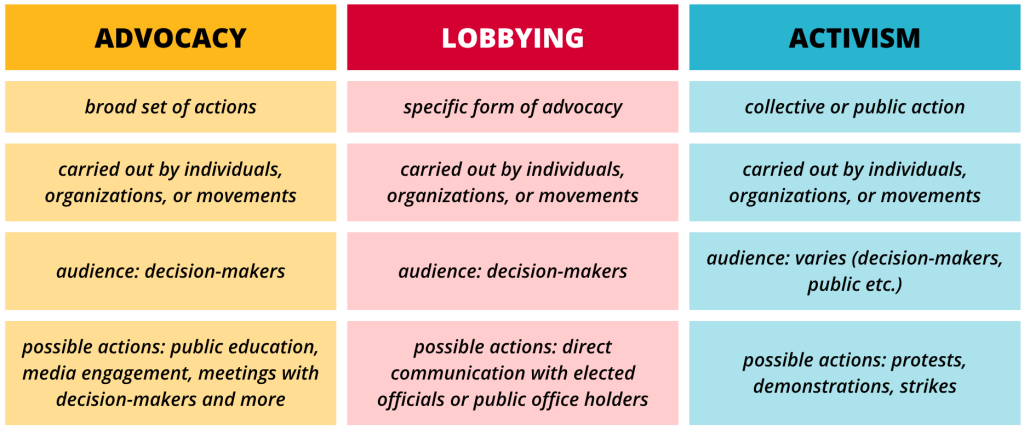
These terms are often used interchangeably, but they have important distinctions.
- Advocacy is a broad set of actions aimed at influencing change through engaging whoever the ultimate decision-maker is. It can include public education, coalition-building, media engagement, and direct engagement with decision-makers through meetings or events. Advocacy can be carried out by individuals, organizations, or movements.
- Lobbyingis a specific form of advocacy that involves direct communication with elected officials or public office holders to influence legislation, policies, or funding decisions. In Canada, lobbying is regulated, and organizations that lobby must follow specific legal and reporting requirements. Lobbying is one tactic within advocacy, but not all advocacy is lobbying. You can learn more about lobbying rules in Canada here.
- Activism refers to collective or public action aimed at drawing attention to an issue or demanding change. This can include protests, demonstrations, strikes, or other forms of visible action. Activism plays an important role in shifting public narratives and applying pressure, and it often works alongside advocacy efforts.
the role of advocacy in canada’s international cooperation sector
Canada plays an important role in shaping global outcomes through its international assistance, multilateral partnerships, diplomatic engagement, and domestic policy decisions. These choices affect access to health services, education, economic opportunity, and human rights for communities around the world. Yet these priorities are not fixed. They are shaped by political choices, and political choices can be influenced.
Advocacy ensures that global issues remain visible within Canada’s political landscape. It helps translate global solidarity into concrete commitments, whether through increased funding for organizations or initiatives, stronger policy frameworks, or improved accountability mechanisms. Without sustained public engagement, international cooperation can be deprioritized in favour of domestic political pressures or short-term considerations.
Civil society organizations, and the Canadian public play a critical role in generating the political will necessary for Canada to act responsibly and ambitiously on global issues. Advocacy connects evidence and lived experience to decision-making spaces. When individuals and organizations raise their voices, build coalitions, and engage decision-makers strategically, they help shape how Canada shows up on the global stage. Advocacy strengthens the connection between global citizenship and democratic participation. It transforms concern about global issues into action that influences national policy and international commitments. In doing so, it reinforces the idea that global cooperation is not only a government responsibility, but also a shared public responsibility.
advocacy as civic engagement:
why it matters in democracies
Advocacy is a vital part of healthy democracies. Civil society plays a critical role in identifying challenges, proposing solutions, and holding institutions accountable. Advocacy helps bridge the gap between communities and decision-makers, ensuring that policies reflect lived realities and diverse perspectives. In the context of global issues where impacts are often felt far from where decisions are made, advocacy helps bring global realities into national conversations. It creates space for dialogue, learning, and collective responsibility.
Advocacy also reinforces the idea that change is not limited to those in positions of formal power. By engaging in advocacy, individuals and organizations contribute to shaping the systems that influence global cooperation, development priorities, and Canada’s role in the world.
In the next module, we will start to unpack how to be strategic when designing your own advocacy goals.

glossary of key terms
ACTIVISM
Collective or public action that seeks to draw attention to issues and demand change.
ADVOCACY
Conducting actions to influence decision-makers to bring about specific changes.
CIVIL SOCIETY
Organizations and groups that operate outside of government and the private sector, often representing community interests and values.
LOBBYING
Direct communication with public office holders to influence legislation, policy, or funding decisions.
PUBLIC ENGAGEMENT
Activities that inform, involve, and mobilize people to participate in shaping decisions and systems.
conclusion
Throughout this module, you explored what advocacy is, how it differs from activism and lobbying, and the types of outcomes it can generate, from shaping the policy agenda and funding commitments. You have also seen that advocacy is not reserved for experts or insiders. It is a skill that can be learned and practiced by individuals and organizations alike.
Understanding what advocacy is provides your foundation. The next step is learning how to focus your efforts effectively. In the following module, you will move from defining advocacy to defining your issue, examining the context, identifying the root problem, and crafting a clear and strategic ask that can influence real-world decisions.
summary / key takeaways
- Advocacy is a broad, values-driven approach to influencing systemic change.
- Lobbying and activism are distinct but complementary forms of advocacy.
- Advocacy plays a critical role in Canada’s international cooperation sector by shaping policies, priorities, and public understanding.
- As a form of civic engagement, advocacy strengthens democratic participation and ensures diverse voices are heard.
- Advocacy can be practiced by individuals and organizations, and learning to do it well begins with understanding its purpose and possibilities.